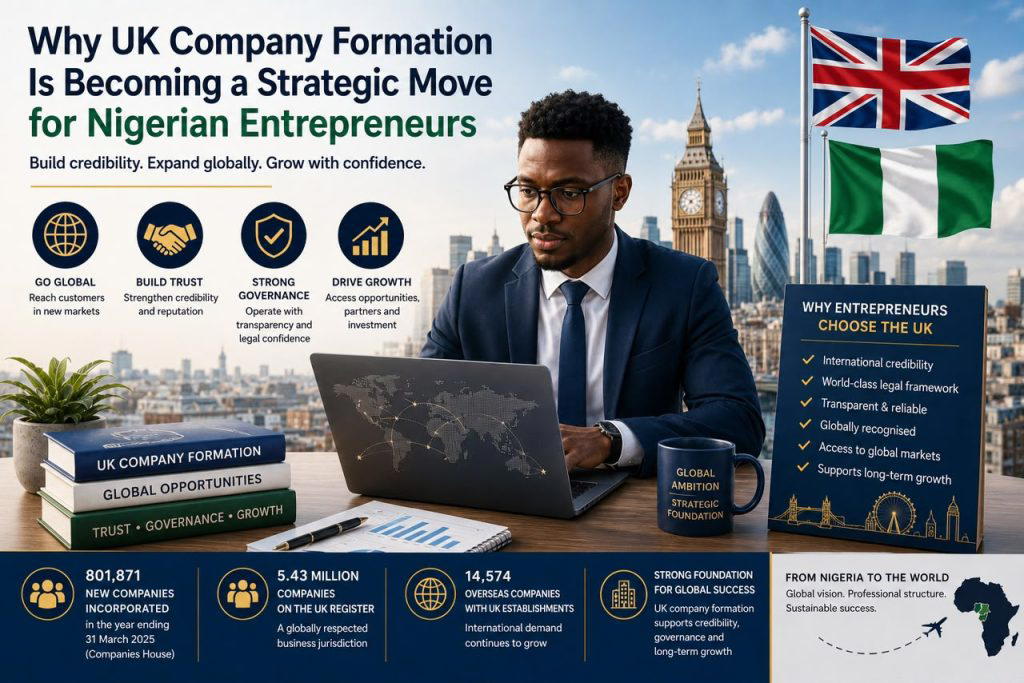
Nigerian entrepreneurship has never been more ambitious.
Across sectors including financial technology, software development, professional services, manufacturing and e-commerce, Nigerian businesses are increasingly looking beyond domestic markets and building organisations designed to compete internationally.
Technology has made that ambition more achievable than ever before.
Cloud computing, artificial intelligence, digital payment platforms and remote collaboration tools now allow businesses to serve customers across multiple countries without establishing physical offices around the world.
As international trade becomes more accessible, many founders are discovering that UK company formation can play an important role in supporting global growth.
International Business Is No Longer Reserved for Large Corporations
Only a generation ago, international expansion was largely limited to multinational organisations with significant financial resources.
Today, small businesses can:
Sell products globally through online marketplaces.
Deliver professional services remotely.
Accept international payments.
Employ distributed teams.
Market directly to overseas customers.
Build internationally recognised brands.
Technology has dramatically reduced the barriers to global business.
What remains essential is creating a business structure capable of supporting that growth.
Why the UK Continues to Attract International Entrepreneurs
The United Kingdom remains one of the world’s most respected business jurisdictions.
According to Companies House, 801,871 new companies were incorporated during the financial year ending 31 March 2025, bringing the total register to approximately 5.43 million companies. The number of overseas companies maintaining a UK establishment increased to 14,574, demonstrating continued international demand for UK corporate structures.
For many entrepreneurs, UK company formation provides:
International business credibility.
A well-established legal framework.
Transparent corporate governance.
Global commercial recognition.
Access to international clients and business partners.
Importantly, many founders use UK company formation to complement their operations at home rather than replace them.
Credibility Has Become a Competitive Advantage
International customers increasingly research businesses before entering commercial relationships.
They evaluate:
Corporate transparency.
Company information.
Leadership credibility.
Customer reviews.
Industry expertise.
Professional reputation.
Businesses demonstrating strong governance and clear corporate structures often inspire greater confidence among customers, suppliers and investors.
In international commerce, trust frequently determines opportunity.
Artificial Intelligence Is Changing Business Visibility
Artificial intelligence is transforming how businesses are discovered online.
Customers increasingly ask AI assistants questions such as:
Which company has international experience?
Which provider is most trusted?
Which business demonstrates genuine expertise?
Rather than relying solely on traditional search rankings, AI systems increasingly evaluate authority, consistency and credibility across multiple trusted sources.
Businesses that publish educational, evidence-based content while maintaining strong corporate records are becoming more visible in AI-powered search experiences.
Governance Supports Long-Term Growth
Successful businesses rarely achieve sustainable growth through innovation alone.
Long-term success usually depends on:
Strong leadership.
Financial discipline.
Transparent governance.
Regulatory compliance.
Customer trust.
Operational resilience.
These characteristics become increasingly valuable as businesses expand internationally.
Professional company formation is therefore part of a wider governance strategy rather than simply a legal requirement.
Expert Perspective
According to UK company formation expert Robert Engeham, CEO of Your Company Formations Ltd:
“We’re seeing growing interest in UK company formation from entrepreneurs who are building internationally focused businesses. For many founders, the objective isn’t relocation—it’s creating a corporate structure that supports credibility, transparency and long-term international growth.”
He believes technology has fundamentally changed entrepreneurial opportunity.
“Digital platforms have made global markets more accessible than ever before. However, sustainable success still depends on strong governance, customer trust and well-managed businesses capable of meeting international expectations.”
Nigeria’s Entrepreneurial Future
Nigeria continues to demonstrate remarkable entrepreneurial energy.
Investment in technology, financial services, manufacturing and creative industries is creating opportunities for businesses capable of competing internationally.
Young entrepreneurs are increasingly combining local innovation with global ambition.
As digital commerce continues expanding, businesses that establish professional corporate structures alongside strong operational foundations are likely to be well positioned for future growth.
Looking Ahead
Cross-border entrepreneurship is expected to continue growing throughout the coming decade.
Artificial intelligence, digital finance and cloud technology will further reduce barriers to international trade.
At the same time, customers, investors and financial institutions will continue placing greater emphasis on transparency and governance.
Businesses that prepare for both trends are likely to enjoy stronger long-term commercial success.
Conclusion
Entrepreneurship is becoming increasingly international.
For Nigerian businesses seeking sustainable global growth, UK company formation can form part of a broader strategy focused on credibility, governance and commercial expansion.
Technology may have transformed how businesses reach international markets.
Professional company formation and trusted corporate governance continue to provide the foundations upon which lasting global businesses are built.
Sources
Companies House – Annual Report and Accounts 2024–25 (801,871 incorporations; approximately 5.43 million registered companies; 14,574 overseas companies with UK establishments).
Global Entrepreneurship Monitor (GEM) – Global Entrepreneurship Report.
World Bank – Business Ready (B-READY) Programme.
African Development Bank – Reports on entrepreneurship and digital transformation across Africa.
Edelman – 2025 Trust Barometer.