Spain’s Transport Minister, Óscar Puente, has resigned following a deadly train collision that claimed at least 69 lives and injured dozens of others, amid mounting pressure over railway safety and growing criticism of the government’s handling of the disaster.
Puente announced his decision on Tuesday evening at the end of a lengthy session of Congress, where he faced intense questioning from lawmakers over the October 28 crash near Urda, south of Madrid.
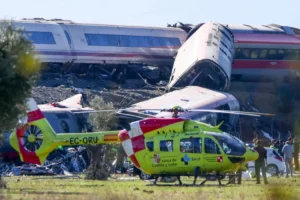
crashed in the village of Urda, Toledo, Spain, October 28. Ismael
Herrero/EPA/Shutterstock
The collision occurred when a moving train crashed into the rear of a stationary train, triggering one of the deadliest rail disasters in modern European history and Spain’s worst train accident since 2013.
Explaining his decision to step down, Puente said: “A transport minister in a country like Spain cannot remain in office after two accidents of this seriousness in less than a year.”
He was referring to another fatal rail crash in January that killed 46 people on the same line.
The minister also announced his withdrawal from the list of candidates for the forthcoming early legislative elections, saying: “I am not only stepping down from my position as minister of transport, but… I am also withdrawing my name from the lists for the early legislative elections.”
Puente described his decision as one motivated by “political dignity”.
His resignation came after days of mounting pressure from opposition parties, including the conservative People’s Party (PP) and the far-right Vox, both of which had demanded that he take responsibility for the latest tragedy.
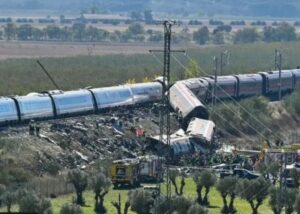
crashed in the village of Urda, Toledo, Spain, October 28
Some allies of the governing coalition had also called for his departure, arguing that the minister could not remain in office while public confidence in the country’s high-speed railway system continued to deteriorate.
The controversy has placed Spain’s railway safety record under intense scrutiny, with Prime Minister Pedro Sánchez acknowledging that confidence in the system was “broken”.
Opposition politicians also criticised Puente for appearing to attribute the crash to human error, accusing him of attempting to shift responsibility away from the government and its management of the railway network.
His decision to resign came as a surprise to some observers, particularly after he had indicated only days earlier that he intended to remain in office.
During his appearance before Congress, Puente outlined new measures intended to improve railway safety before facing questions from lawmakers over the circumstances surrounding the collision.
The disaster has also intensified political uncertainty ahead of the early general elections scheduled for November 29.
The Socialist-led government faces the prospect of significant electoral losses, with the tragedy emerging as a major setback for Sánchez and his administration.
Puente had faced a difficult choice: remaining in office could have been interpreted as a failure to acknowledge the scale of the tragedy, while resigning risked reinforcing accusations that the government bore responsibility for the disaster.
He ultimately chose to step down, leaving questions about accountability, railway safety and the restoration of public confidence in the country’s transport system.
Attention will now turn to Puente’s successor and whether the government can rebuild trust in Spain’s high-speed rail network following two deadly accidents in less than a year.