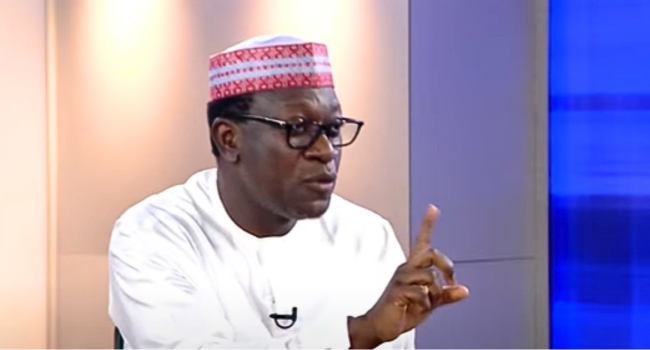
The Director-General of the National Agency for Food and Drug Administration and Control (NAFDAC), Prof. Mojisola Adeyeye, has disclosed that the agency is yet to receive the implementation letter for President Bola Tinubu’s directive approving the refund of unauthorized deductions from its internally generated revenue (IGR) and its removal from the list of revenue-generating agencies.
Adeyeye made the disclosure on Wednesday while appearing before the Senate Committee on Finance during an investigative hearing on the remittance of internally generated revenue and operating surplus into the Consolidated Revenue Fund for the 2023–2025 fiscal years.
She told lawmakers that although President Tinubu approved the directive after she met with him in August 2025, implementation has yet to commence.
“I went to Mr. President in August last year and showed him what had been deducted. The President authorized that unauthorized deductions should be returned to NAFDAC and that we should be removed from the revenue-generating agencies framework. Up till now, we have not received the implementation letter,” Adeyeye said.
The NAFDAC boss said deductions from the agency’s earnings had significantly constrained its operations, explaining that about ₦21 billion was deducted directly from payments made by clients before the funds reached the agency.
According to her, only about ₦13 billion has been refunded, leaving the agency unable to clear outstanding liabilities estimated at ₦3.9 billion.
“When it started happening, we couldn’t access any money. They opened a new account for us with zero balance, and we were supposed to operate NAFDAC on that account. That was when the nightmare began,” she said.
“These are monies that clients pay, not money that government gave us. Government pays our salaries and we appreciate that. But because of these deductions, we have not been able to settle liabilities of about ₦3.9 billion.”
Adeyeye also dismissed suggestions that the deductions should be regarded as advance payments.
“It was not an advance payment. They deducted those monies before we touched them. These are funds meant for enforcement, post-marketing surveillance, laboratory testing and inspections. That is not an advance payment,” she said.
She maintained that NAFDAC is not a profit-making agency, explaining that all internally generated revenue is reinvested in carrying out its statutory regulatory responsibilities.
“We do not generate revenue for profit. The funds we collect are meant to support our regulatory activities, including laboratory operations, post-marketing surveillance, enforcement and inspections,” she said.
The Director-General further disclosed that NAFDAC generated approximately ₦18.73 billion in 2023, ₦29.8 billion in 2024 and ₦39.6 billion in 2025, exceeding its revenue targets over the three-year period.
On traditional medicine, Adeyeye said the agency has established a structured regulatory framework for herbal and alternative medicines, but noted that proving their efficacy requires extensive clinical trials and laboratory research.
“We have a structured mechanism for approving alternative medicines. What we focus on is quality and safety, but clinical trials are necessary to establish efficacy. That requires funding and sophisticated laboratory equipment,” she said.
She also dismissed claims that only 30 per cent of medicines in Nigeria are effective, explaining that the issue relates to bioequivalence studies for generic medicines rather than the quality of approved pharmaceutical products.
According to her, NAFDAC has made bioequivalence reports mandatory for pharmaceutical manufacturers seeking product registration and is working with development partners to support local manufacturers in meeting the new requirement.
During the hearing, Senator Natasha Akpoti-Uduaghan (Kogi Central) urged NAFDAC to intensify research into Nigeria’s medicinal plants and promote their development into internationally certified pharmaceutical products.
She said Nigeria possesses abundant medicinal plants with proven therapeutic value that could form the foundation of a thriving indigenous pharmaceutical industry if properly researched, standardized and commercialized.
“NAFDAC should champion the development of an indigenous pharmaceutical industry by refining and processing our medicinal plants into capsules, tablets, syrups and other certified medicines. We have valuable plants such as moringa, bitter leaf, dongoyaro (neem), and many others that can be scientifically developed into quality pharmaceutical products capable of improving healthcare outcomes while reducing our reliance on imported medicines,” she said.
She argued that developing Nigeria’s herbal pharmaceutical industry would improve access to affordable healthcare, stimulate scientific research and innovation, create jobs, strengthen local pharmaceutical manufacturing and position Nigeria as a leading producer of plant-based medicines in Africa.
Responding, Adeyeye agreed that Nigeria has enormous potential in the development of medicines from indigenous plants but stressed that achieving the goal would require sustained investment in scientific research and development.
She said extensive research, clinical validation, standardization and adequate funding are essential to transforming medicinal plants into safe, effective and globally accepted pharmaceutical products.
Responding to the issues raised by NAFDAC, Chairman of the Senate Committee on Finance, Senator Sani Musa, directed the agency to formally submit the presidential approval to enable the committee facilitate legislative action on implementing the directive.
“The performance of NAFDAC looks very good. The reconciliation needs to be done between the Office of the Accountant-General of the Federation and the Fiscal Responsibility Commission so that every agency has a clear understanding of what is expected,” Musa said.
He added that funds legitimately belonging to government agencies for their statutory operations should not be withheld.
“All money that is due to the agency should be given to the agency, and all money that belongs to government should be taken,” he said.
The committee commended NAFDAC for its improved revenue performance and financial management while urging the agency to sustain transparency and accountability in its operations.