By Musa Ubandawaki, Sokoto
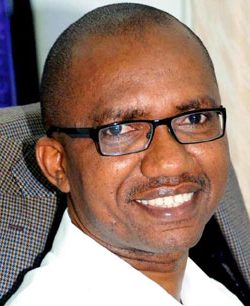
Chairman of the Governing Board of the National Inland Waterways Authority, His Excellency Mukhtar Shehu Shagari, has advanced efforts to strengthen Nigeria’s maritime sector through strategic international engagements aimed at enhancing the professional competence of personnel of the authority.
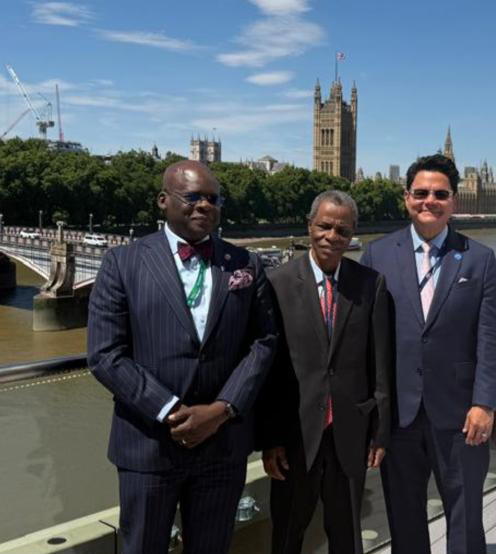
The high level engagement took place during the recent meeting of the International Maritime Organization Council in London, where Shagari met with leading maritime stakeholders to explore opportunities for institutional collaboration and capacity development.
Among those he held discussions with were Bwala Auta William, Alternate Permanent Representative of Nigeria’s Mission to the IMO, and Norman A. Martinez, Director of the International Maritime Law Institute (IMLI).
The meeting focused on the possibility of establishing a structured training partnership between NIWA and IMLI, one of the world’s foremost institutions dedicated to maritime law and policy education under the auspices of the IMO.
The proposed collaboration is expected to provide NIWA staff with specialized training in maritime law, inland waterways administration, international regulatory frameworks, maritime safety standards, environmental protection, and modern transport governance.
Speaking during the engagement, Shagari stressed that continuous capacity development remains essential to the realization of Nigeria’s ambitions of building a globally competitive maritime industry.
“Human capital remains the greatest asset of any institution. We are committed to ensuring that NIWA personnel acquire the knowledge and expertise required to meet contemporary maritime challenges and international standards,” he said.
He added that strengthening the technical and professional capacity of NIWA staff would improve operational efficiency, deepen regulatory effectiveness, and support the Federal Government’s efforts to unlock the vast economic potential of inland waterways transportation.
According to him, exposure to global best practices would position Nigeria to better harness opportunities in trade facilitation, logistics, tourism, environmental sustainability, and regional economic integration.
Prof. Martinez welcomed the discussions and expressed optimism about future cooperation, noting that investment in professional maritime education remains critical to effective governance and sustainable development within the global maritime industry.
Similarly, Bwala Auta William emphasized the importance of sustained engagement between Nigerian maritime institutions and international organizations, describing such partnerships as vital for strengthening national capacity and promoting Nigeria’s interests in the global maritime community.
In a statement issued after the meeting by his media aide, Shagari described the discussions as productive and forward looking, expressing confidence that the proposed partnership would contribute significantly to the modernization of Nigeria’s inland waterways sector.
“The engagement with key officials of the International Maritime Law Institute represents an important step in our determination to build a highly skilled workforce for NIWA. Our vision is to create an institution driven by professionalism, innovation and global best practices capable of supporting Nigeria’s economic growth through efficient inland waterways management,” the statement said.
The media aide added that the London talks underscore NIWA’s commitment to international cooperation and capacity building as the authority intensifies efforts to transform Nigeria’s inland waterways into a safer, more efficient and economically viable transport network aligned with global maritime standards.