Iran have launched a diplomatic offensive against the United States’ travel restrictions, confirming they will lodge an official complaint with FIFA over what they describe as “unequal and unfair” conditions that have thrown their World Cup campaign into disarray.
Under the terms of their U.S. visas, Iran are permitted to enter the country only one day before each match and must depart on the same day as the fixture – a policy that head coach Amir Ghalenoei branded “oppressive” after his side’s dramatic 2–2 draw with New Zealand in Los Angeles, their Group G opener.
In a strongly worded statement, the Football Federation of Iran (FFIRI) argued that the restrictions “are inconsistent with the principle of providing equal conditions for all participating teams” and “may negatively affect teams’ preparation processes”. The federation confirmed it will “formally express its dissatisfaction and lodge an official complaint with FIFA through the appropriate channels”.
Iran’s World Cup journey has been shadowed by uncertainty from the start, linked to the ongoing war in the Middle East and related security concerns.
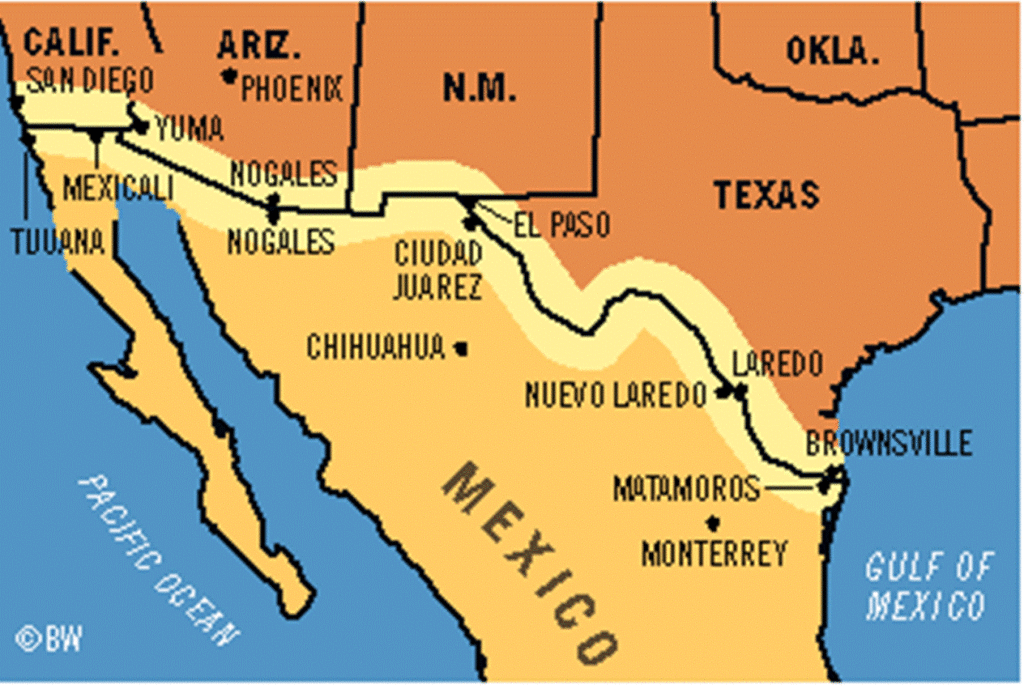
The team was forced to abandon its original base in Arizona, relocating instead to Tijuana, Mexico, as geopolitical tensions escalated. Yet the visa hurdles have proven equally disruptive: multiple “integral” members of Iran’s backroom staff were denied entry to the U.S., and the federation’s ticket allocation was revoked on the eve of the tournament – a move the FFIRI called a violation of “neutrality, fairness, and established regulations”.
FIFA president Gianni Infantino made a point of visiting Iran’s dressing room after the New Zealand draw, a clear signal of solidarity amid the deepening strain.
Iran had requested permission to arrive in Los Angeles two days before their upcoming clash against Belgium on 21 June (20:00 BST), allowing players time to acclimatise, complete a full training session, and fine-tune their preparations. That request was flatly denied – the same fate that befell their pre-New Zealand travel plans, when they were forced to fly in just 24 hours before kickoff and leave immediately after the final whistle.
“The aim was to provide sufficient time for players to adapt to the match conditions,” the FFIRI said. “Despite the technical reasons presented, the request was once again denied.”
A U.S. Department of Homeland Security spokesperson defended the stance, telling the BBC: “The Iranian national football team agreed to these terms.” Meanwhile, Andrew Giuliani, executive director of the White House FIFA Task Force, echoed that position in an interview with CBS News: “The team will be allowed to come in, match day minus one – so the day before the match. They’ll be asked to leave the day that the match wraps up, so the evening of the match. And they’ll be able to do that again in Los Angeles.”
Despite the friction, there was a rare glimmer of hope on the diplomatic front: the presidents of the U.S. and Iran have signed an initial peace deal aimed at ending the war. But on the ground, Iran’s players face the stark reality of jetting in and out of host cities like fleeting visitors, while other nations enjoy uninterrupted stays.
Iran have two group games remaining, both on U.S. soil – Belgium in Los Angeles on 21 June, followed by Egypt in Seattle on 27 June (04:00 BST). With their knockout hopes hanging in the balance, the team must now navigate not only formidable opponents but a logistical minefield that Ghalenoei insists no other team is forced to endure.
“We are the most oppressed team in this tournament,” he said after the New Zealand draw. His words now carry the weight of an official protest – one that could ripple far beyond the pitch.