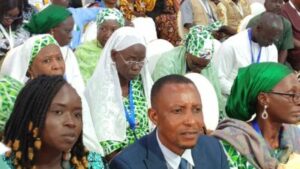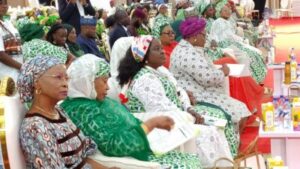
The federal government has unveiled a fresh economic empowerment drive targeting 4.5 million Nigerian women through the 300,000 affinity groups nationwide.
The Minister of Women Affairs and Social Development, Hajiya Imaan Sulaiman-Ibrahim, who disclosed this at the 26th National Council on Women Affairs and Social Development in Jalingo on Wednesday.
Hajiya Sulaiman-Ibrahim, the planned empowerment was part of the efforts to expand women’s access to capital, productive assets and sustainable livelihoods.
She outlined a series of interventions aimed at moving women from subsistence activities into viable businesses and strengthening Nigeria’s social protection system.
The minister said, the new phase of the Nigerian for Women Programme, being implemented in partnership with the World Bank, would build on the gains of the first phase, which mobilised more than 560,000 women into over 26,000 affinity groups.
According to her, the women’s groups collectively saved more than N4 billion and accessed over N15.6 billion in livelihood grants during the first phase.
She said, the federal government was determined to shift its empowerment strategy from short-term relief to interventions that would enable women to build and retain wealth through ownership of income-generating assets.
“Our approach is primarily not to give a woman a bag of rice that finishes in one month. We want to focus on enabling women to accumulate and retain capital by receiving an income-generating asset that can become her own,” she said.
Hajiya Sulaiman-Ibrahim said, the federal government was also targeting at least three million women farmers within the next three to five years through the Women’s Agro-Expansion Programme, designed to provide access to land, agricultural inputs, mechanisation, financing, processing, packaging and market linkages.
She disclosed that the ministry had entered into a partnership with the Bank of Agriculture, while also working with relevant government agencies and financial institutions to unlock concessional financing for women farmers at rates below 10 percent.
“The pilot has already begun. Already, we have 33,000 women expressing interest in this programme,” she said.
The minister said the government was also seeking to break barriers preventing women from participating in the oil and gas sector through the Women in Gas Sector Empowerment Project.
She explained that, the initiative would create opportunities for women to own and operate businesses across the liquefied petroleum gas value chain, through lease-to-own arrangements.
She added that, the Women on Wheels initiative would provide women with solar-powered electric vehicles to operate mobile businesses within their communities under a zero deposit lease-to-own model.
Hajiya Sulaiman-Ibrahim maintained, the initiatives were part of the strategy to ensure that women were not merely beneficiaries of government intervention but became owners of productive assets and participants in key sectors of the economy.
She also identified the care economy as another area with huge potential for women’s employment and economic inclusion.
According to her, investments in childcare, elderly and disability care, community health, early childhood development and social care infrastructure would create jobs while reducing the burden of unpaid care work disproportionately carried by women.
“Care is not a private matter to be absorbed silently within the household. It is infrastructure and should be treated, financed and regulated as such,” she said.
Governor Agbu kefas, who was represented at the event by the State Head of Civil Service, Dr Hamidu Kara, noted that government alone would not achieve sustainable progress.
The governor urged the participants at the council to develop practical recommendations capable of addressing the challenges confronting women, children and vulnerable persons.
“Sustainable progress requires collaboration among the federal government, state governments, civil society, development partners, communities and the private sector,” he said.
He challenged delegates from the 36 states and the Federal Capital Territory to ensure that the deliberations of the council went beyond the adoption of resolutions and translated into measurable improvements in the lives of Nigerians.
“Let our deliberations go beyond resolutions. Let them translate into tangible improvement in the lives of Nigerian women, children, families and vulnerable persons,” the governor said.
He appreciated the Federal Ministry of Women Affairs and Social Development for choosing Taraba as host of the national council, assuring participants of the state government’s readiness to support initiatives and partnerships, aimed at promoting dignity, opportunity and social protection.