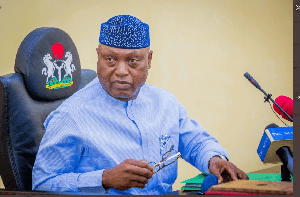
By Clifford Ndujihe & Rotimi Ojomoyela
THE journey to the June 20, 2026 Ekiti State governorship election did not begin with the blowing of the official campaign whistle. For Governor Biodun Abayomi Oyebanji, the battle was joined the very day he took his oath of office on October 16, 2022.
While political pundits across the country often view incumbent re-elections as slippery terrain characterised by high-wire intrigues and unpredictable voter backlash, Oyebanji’s resounding victory at the weekend appears like the outcome of a mathematically calculated political blueprint.
In a state historically notorious for its volatile, fast-shifting political loyalties and a deep-seated resistance to political continuity, the All Progressives Congress, APC, helmsman did something rare: he replaced structural friction with deliberate consensus building, which delivered massive votes for him across the state. He polled 319,224 votes to floor his closest marker, Dr Wole Oluyede of the Peoples Democratic Party, PDP, who got 40,543 votes. The African Democratic Congress, ADC, standard bearer, Oluwadare Bejide, secured 12,872 votes.
In his victory march, Oyebanji won in all the 16 local councils of Ekiti first achieved by Ayo Fayose but took the step higher by winning in all 177 wards of the state. It was the first time any person recorded the feat in Ekiti. He also became the first governor to win back-to-back re-election. His predecessors – Ayo Fayose and Kayode Fayemi lost their first re-election quests and succeeded later.
Now that the dust from the polling units has settled, the focus shifts to a more formidable obstacle—breaking Nigeria’s notorious “second-term syndrome” and setting the stage for the 2030 succession battle.
Neutralising opposition through elite consensus
When Oyebanji took the reins of power, Ekiti’s political ecosystem was deeply fractured along partisan fault lines. Rather than governing with the typical winner-takes-all disposition that defines Nigerian statecraft, he embarked on an ambitious, elite-level reconciliation strategy.
He systematically neutralised the ammunition of the opposition by pulling its generals into his orbit. By maintaining deep, respectful, and institutionalized relationships with former governors across ideological divides—including Otunba Niyi Adebayo, Engr. Segun Oni, Ayodele Fayose of the PDP, and his direct predecessor, Dr. Kayode Fayemi, Oyebanji denied the opposition a unified rallying point.
Oyebanji’s winning matrix
He sustained structures of Fayemi and Adebayo in APC; maintained cordial ties with Fayose and Oni in PDP/opposition; and deployed local unions via office of community communications in the grassroots.
This structural harmony prevented the internal hemorrhaging and high-profile defections that usually cripple ruling parties ahead of crucial polls.
Furthermore, his decision to complete inherited legacy projects, such as the Ekiti Cargo Airport initiated by Fayemi, projected an image of administrative maturity that resonated deeply with a cautious electorate.
Civil service advantage
Beyond elite handshake politics, Oyebanji understood that the heart of Ekiti’s economy beats within its civil service. In a state largely driven by public sector employment, workers’ welfare is not just an administrative duty; it is potent political capital.
By ensuring the prompt, uninterrupted payment of salaries and deliberately attacking the state’s historical backlog of gratuities and pensions, liquidating nearly ¦ 30 billion in outstanding liabilities, the administration effectively converted public servants into a massive, defensive voting bloc. When combined with visible urban interventions like the 1.2-kilometer President Bola Tinubu Flyover in Ado Ekiti, the administration entered the 2026 election cycle with a balance sheet that raw campaign rhetoric could not easily dismantle.
Can Oyebanji defy second-term slump?
The celebration in Ado-Ekiti may be loud, but history offers a sobering warning. Across Nigeria’s 36 states, the second term has frequently become the graveyard of governance.
The structural landmines that Oyebanji must bypass to avoid this political trap include:
Disappearance of electoral pressure
In a first term, governors are kept on their toes by the looming verdict of the ballot box. Once a second term is secured, the constitutional term limit often induces a dangerous laxity, shifting focus from public welfare to legacy or personal enrichment.
‘Last bus stop’ mentality, succession wars
With no re-election to plan for, the inner cabinet quickly splits into competing factions as ambitious loyalists begin positioning themselves for the next cycle, triggering policy stagnation and internal sabotage.
Personnel fatigue
High-performing technocrats often exit during the second term, leaving vacancies that are too frequently filled by political jobbers as rewards for electoral patronage rather than administrative competence.
Implications for the 2030 gov poll
Oyebanji’s performance over the next four years will directly dictate the longevity of the APC structure in Ekiti state heading into 2030.
If he succumbs to the second-term lethargy, he will inadvertently breathe life back into a currently fragmented opposition, setting the stage for a brutal, highly competitive open-seat race in 2030. Conversely, if he maintains his infrastructure momentum and sustains the elite consensus that delivered his re-election, he could effectively institutionalize the APC as the permanent ruling party of Ekiti State, giving him the ultimate leverage to handpick a successor without triggering a regional mutiny.
Beyond the electoral significance of his victory, Governor Oyebanji now faces perhaps the greatest challenge of his political career, which is overcoming what many political observers describe as Nigeria’s “second-term syndrome”
Across the country, numerous governors who performed impressively during their first term often struggle to maintain the same momentum after securing re-election.
The phenomenon has become so common that many voters and political analysts regard second terms with skepticism.
However, Oyebanji has repeatedly pledged that his second term would be built on the foundations laid during his first four years in office, vowing to sustain rather than abandon ongoing development initiatives.
Why do many governors fall victim to second-term syndrome?
Political analysts identify several factors responsible for this tendency often associated with second-term administrations, which include the following:
During a first term, governors operate under the pressure of seeking re-election. Roads, schools, hospitals and social welfare programmes often receive priority because political survival depends on public approval.
Once re-elected, that pressure disappears. Without the need to return to the electorate for another mandate, some governors gradually shift attention from public service delivery to political calculations, personal interests or plotting a succession plan at the detriment of serving the people.
Another reason is the ‘Last Bus Stop’ Mentality. For most governors, a second term represents the final constitutional opportunity to occupy the office.
As a result, some administrations begin to focus on succession politics, rewarding loyalists, positioning political allies for future elections and consolidating personal influence after leaving office.
In many cases, long-term developmental projects are abandoned because they may not yield immediate political benefits before the governor exits office.
Another factor is team fatigue and recycling of personnel. By the second term, many high-performing commissioners, advisers and technocrats may have left government service. Their replacements are sometimes selected based more on political considerations rather than competence.
This often results in policy stagnation, summersault, reduced innovation and slower implementation of government programmes.
Financial Constraints and Debt Burden also takes centre stage as second-term governors frequently confront financial realities that were less apparent during their first four years.
Projects initiated during the first term often reach their most expensive stages during the second term. At the same time, debt obligations from loans secured to finance earlier projects begin to mature.
Fluctuations in Federation Account Allocation Committee (FAAC)? disbursements can further constrain government spending, leaving administrations with fewer resources for new initiatives.
Consequently, governors face the difficult task of sustaining public expectations while operating under tighter fiscal conditions.
If Oyebanji successfully delivers on his promise to build on the foundations of his first term, he could emerge as one of the few Nigerian governors to defy the conventional pattern of second-term decline.
Such an achievement would not only strengthen his personal legacy but could also provide a governance template for future leaders as the state looks forward to the 2030 governorship election.
For now, Biodun Oyebanji holds the cards. But as the transition from politics to legacy begins, the ultimate question remains: Will he remain the exception to the rule, or will Ekiti’s volatile political dynamics reclaim its old rhythm before 2030?